Film · 1995
Braveheart
William Wallace was real. So were Stirling Bridge, Falkirk and his execution in London. Almost everything the 1995 film wraps around those events is not.
Diagram
What really happened
Scotland was not under English rule in 1280. King Alexander III was alive and so were his sons. He died in 1286. His granddaughter and heir died in 1290, and the Scottish nobles asked Edward I of England to judge between the rival claimants. He chose John Balliol in 1292, treated Scotland as a dependent kingdom, and in 1296 deposed Balliol and took direct control. Historian Sharon Krossa stresses that open war between the two countries began only then, one year before Wallace's rising.[S5][S7][S1] Claim 1 ↓
Very little is known about Wallace before 1297. He was a younger son of a knight and minor landowner from the Lowlands, not a Highland peasant. In May 1297 he and about 30 men burned Lanark and killed its English sheriff, William Heselrig. Men flocked to him. That summer he joined forces with Andrew Moray, who had led a separate rising in the north.[S1][S9][S7][S6] Claims 1, 3 ↓
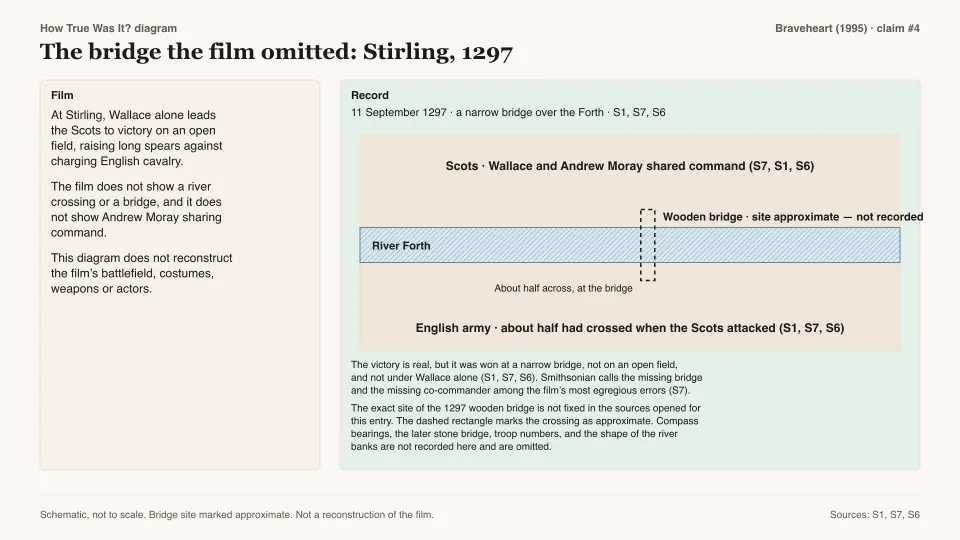
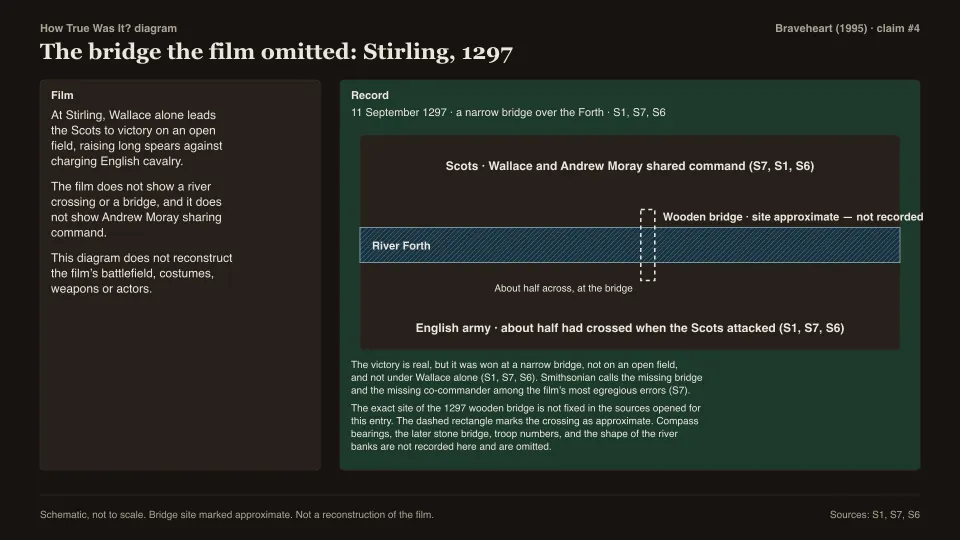
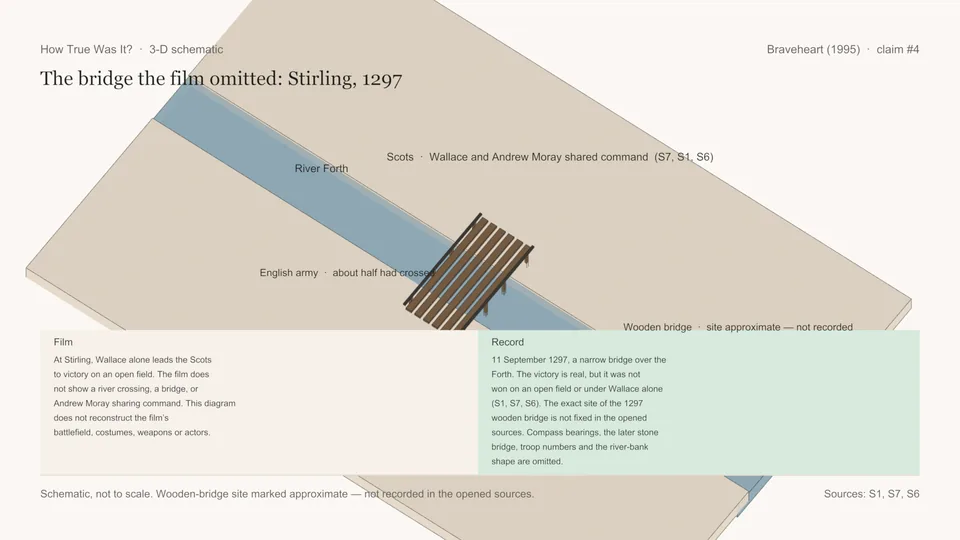
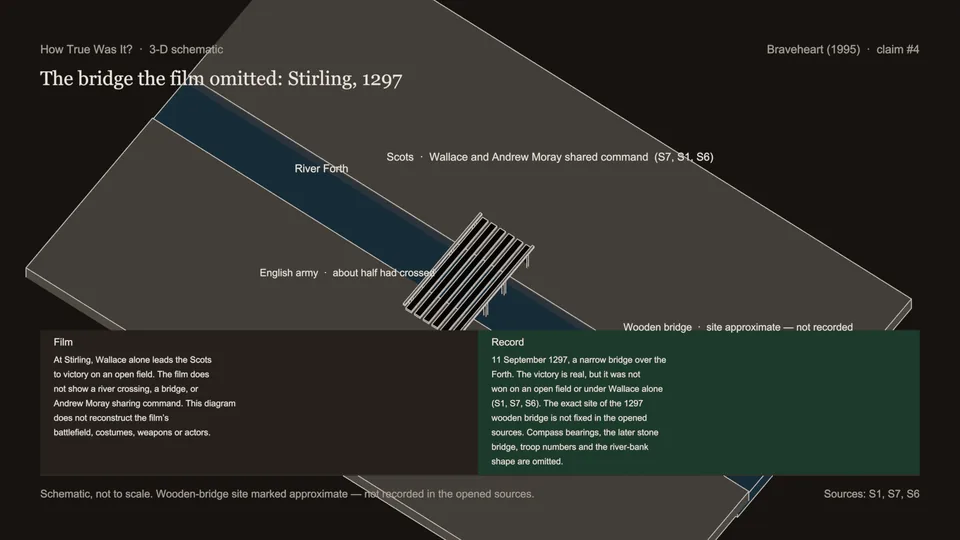
On 11 September 1297 an English army began to cross a narrow bridge over the River Forth at Stirling. Wallace and Moray waited until about half of it was across, then attacked. Most of the English who had crossed were killed or drowned. Moray was wounded and died soon after. Wallace then raided Northumberland and Cumberland, and on his return was knighted and became guardian of the kingdom in the name of the imprisoned King John.[S1][S7][S10] Claims 4, 6–7 ↓
Edward I came north himself in 1298. At Falkirk on 22 July his cavalry drove the small Scottish mounted force off the field, and his archers then broke up Wallace's massed spearmen. Wallace resigned the guardianship that December and was succeeded by Robert the Bruce and John Comyn. For most of the next several years his movements are unknown. He was arrested near Glasgow on 5 August 1305 by a Scottish knight, Sir John Menteith, taken to London, declared a traitor without a trial, and on 23 August hanged, disemboweled, beheaded and quartered.[S1][S7] Claims 9–11 ↓
Edward I outlived him by almost two years. Robert the Bruce had himself crowned King of Scots in March 1306, was at first a hunted fugitive, slowly won back territory with his supporters, and defeated an English army at Bannockburn on 24 June 1314. England recognized Scottish independence in 1328.[S4][S11][S8] Claims 12, 14 ↓
What the film leaves out
Andrew Moray is missing from the film altogether, although Britannica and the BBC both name him beside Wallace at Stirling Bridge, and a letter the two men sent together to the trading towns of Hamburg and Lübeck a month later long survived.[S1][S9] Claim 4 ↓
The film also leaves out how thin the evidence is. Britannica notes that there is no portrait of Wallace and no description of him from his own time, and that many of the best-known stories come from a romance written in the late 1400s and credited to a minstrel known as Blind Harry. Historian C. J. McNamee calls that poem of little value for Wallace's raid on England because it borrows the route of a Bruce invasion from 1322.[S1][S10] Claims 3, 7 ↓
All 14 claims, each rated and sourced
| # | What the film shows | Verdict | What the record shows | Sources | Checked |
|---|---|---|---|---|---|
| 1 | In 1280 Scotland's king is dead without an heir, Edward I has claimed the throne, and the boy William, son of a poor farmer, loses his father to the English. | Invented | Alexander III and both his sons were alive in 1280, and Krossa says there was no armed conflict with England until 1296. Wallace's father was a knight and landowner, not a peasant farmer. The Scotsman reports historian Gary Stewart's view that he was probably still alive during his son's rebellion. Even his name is uncertain: Britannica says Malcolm, while the National Wallace Monument notes that Wallace's own seal names an Alan. | S5 S1 S6 S9 S14 | 2026-11-22 |
| 2 | Edward I gives English lords in Scotland the right to sleep with any commoner's bride on her wedding night. | Invented | Britannica says the evidence that such a right ever existed in medieval Europe is all indirect, and that it probably amounted to a marriage tax paid to the lord. The Scotsman quotes medievalist Albrecht Classen: writers who claim it existed have never cited a trustworthy source. None of the accounts of Edward's rule read for this entry mentions it. | S2 S6 S13 | 2026-11-22 |
| 3 | Wallace rises in revolt because an English sheriff executes the woman he has secretly married, and he kills the sheriff in revenge. | Partly | The killing is real: in May 1297 Wallace killed William Heselrig, the English sheriff of Lanark. The wife is not in the documentary record. Britannica says Wallace was unmarried and traces the popular stories to Blind Harry's romance, written almost two centuries later. TheCollector notes that Blind Harry tells a similar story without naming her, and that the name later attached to her, Marion Braidfute, is disputed. | S1 S9 S13 | 2026-11-22 |
| 4 | At Stirling, Wallace alone leads the Scots to victory on an open field by raising long spears against charging English cavalry. | Partly | The victory on 11 September 1297 is real, but it was won at a narrow bridge over the Forth. The Scots let about half the English army cross and then cut it off. Wallace shared command with Andrew Moray. Smithsonian calls the missing bridge and the missing co-commander among the film's most egregious errors. The exact site of the 1297 wooden bridge is not fixed in the sources opened for this entry; the diagram marks it approximate and not recorded. | S1 S7 S6 | 2026-11-22 |
| 5 | Wallace and his men go into battle in tartan kilts with their faces painted blue. | Invented | Krossa writes that no Scots wore belted plaids, let alone kilts, in the 13th century, or for most of the three centuries after it. The Scotsman quotes author Peter Traquair: the woad is a thousand years too late and the kilt five hundred years too early. | S5 S6 S7 | 2026-11-22 |
| 6 | After Stirling, Wallace is knighted and made Guardian of Scotland. | True | Britannica says that on his return to Scotland in December 1297 he was knighted, by whom is not known, and was elected or assumed the title of guardian of the kingdom, acting in the name of King John Balliol. | S1 S9 | 2026-11-22 |
| 7 | Wallace invades England and takes the city of York. | Partly | He did invade, but he came nowhere near York. In late 1297 his army devastated Northumberland and Cumberland, burned Alnwick and besieged Carlisle. McNamee's study, built on chronicles and tax records, has the Scots turning away near Newcastle and dropping a planned move into County Durham. He adds that Blind Harry's poem gives Wallace the route of Bruce's 1322 invasion of Yorkshire. | S10 S1 S9 | 2026-11-22 |
| 8 | Princess Isabella of France, wife of the future Edward II, meets Wallace as the king's envoy, becomes his lover and carries his child. | Invented | Britannica gives Isabella's birth year as 1292 and her wedding to Edward as 25 January 1308, at Boulogne. Wallace was executed in August 1305. The Scotsman says the two probably never met and that she was a small child living in France at the time of Falkirk. Her son Edward III was born at Windsor on 13 November 1312. | S3 S6 S12 S1 | 2026-11-22 |
| 9 | Wallace loses at Falkirk because Scottish nobles, bought by Edward, ride off the field and leave him. | Partly | The defeat on 22 July 1298 is real, and the Scottish horsemen did leave the field. Britannica says the English cavalry drove off the small mounted force under John Comyn, and that Edward's archers then broke the ranks of spearmen. It mentions no bribe. It does say that some nobles with English estates were only lukewarm toward Wallace. | S1 S7 | 2026-11-22 |
| 10 | Robert the Bruce rides with the English at Falkirk and betrays Wallace on the battlefield. | Invented | Smithsonian reports that there is no historical evidence Bruce was at Falkirk or that he directly betrayed Wallace, though he did change sides several times in those years. Britannica lists Bruce among Wallace's supporters as guardian and says he and Comyn took over the guardianship after Wallace resigned. | S8 S1 S4 | 2026-11-22 |
| 11 | Wallace is handed over through the treachery of fellow Scots, condemned as a traitor in London and publicly hanged, disemboweled and beheaded. | True | He was arrested near Glasgow on 5 August 1305 by Sir John Menteith, by treachery according to two early chroniclers. On 23 August he was condemned at Westminster Hall without a trial, denying he was a traitor because he had never sworn allegiance to Edward, and executed at Smithfield. The film has Bruce's father arrange the capture. Britannica says the elder Bruce died in 1304. | S1 S4 S7 | 2026-11-22 |
| 12 | Edward I dies in his bed at the same moment Wallace is executed. | Invented | Westminster Abbey, where he is buried, records that Edward I died on 7 July 1307 at Burgh on the Sands in Cumberland, almost two years after Wallace. The Scotsman notes he was on his way north to deal with the Scots again. | S11 S6 | 2026-11-22 |
| 13 | “Braveheart” is William Wallace. | Partly | The Scotsman reports that the name belongs to the tradition about Robert the Bruce: Sir James Douglas is said to have carried Bruce's heart into battle and addressed it as the brave heart. Britannica confirms the underlying event. Bruce's heart was removed on his instructions, taken on crusade to Spain by Douglas and later buried at Melrose Abbey. | S6 S4 | 2026-11-22 |
| 14 | In 1314 Bruce arrives at Bannockburn to accept the English king's endorsement, then leads a sudden charge in Wallace's memory and wins Scotland's freedom. | Partly | Bannockburn was a real and decisive Scottish victory on 24 June 1314, but there was nothing sudden about it. Bruce had been crowned king in March 1306 and had been fighting ever since. The battle came when a large English army tried to relieve the garrison of Stirling. England did not recognize Scottish independence until the treaty of 1328. | S4 S8 | 2026-11-22 |
True: supported as shown. Partly: changed in who, when, how or how much. Invented: no sign of it in the record, or contradicted. Unclear: the record is thin or disputed. How we rate. Each row has a permanent link (#claim-N); use Copy link to share one claim.
Sources
- S1The Editors of Encyclopaedia Britannica, “William Wallace”, Encyclopaedia Britannica, 2024-12-05.secondary Link · Archive · accessed 2026-11-22
Via: Internet Archive copy. The live site blocked automated access on the day we checked.
Note: The date is the article's last-updated date on the archived copy. - S2The Editors of Encyclopaedia Britannica, “Droit du seigneur”, Encyclopaedia Britannica.secondary Link · Archive · accessed 2026-11-22
Via: Internet Archive copy. The live site blocked automated access on the day we checked. - S3The Editors of Encyclopaedia Britannica, “Isabella of France”, Encyclopaedia Britannica.secondary Link · Archive · accessed 2026-11-22
Via: Internet Archive copy. The live site blocked automated access on the day we checked. - S4Bruce Webster, “Robert the Bruce”, Encyclopaedia Britannica, 2024-12-16.secondary Link · Archive · accessed 2026-11-22
Via: Internet Archive copy. The live site blocked automated access on the day we checked.
Note: Webster was a senior lecturer in history at the University of Kent. The date is the article's last-updated date. - S5Sharon L. Krossa, “Braveheart Errors: An Illustration of Scale”, Medieval Scotland (MedievalScotland.org), 2008-10-02.secondary Link · Archive · accessed 2026-11-22
Via: Internet Archive copy. The live site blocked automated access on the day we checked.
Note: A historian of medieval Scotland goes through the film's first two and a half minutes line by line. Marked by its author as a draft edition. - S6Finlay Greig, “10 Braveheart inaccuracies: historical blunders in the Mel Gibson film about the Wars of Scottish Independence”, The Scotsman, 2020-05-22.news Link · Archive · accessed 2026-11-22
Via: Internet Archive copy. The live site blocked automated access on the day we checked. - S7Meilan Solly, “How William Wallace of ‘Braveheart’ Fame Defeated the English at the Battle of Stirling Bridge”, Smithsonian Magazine, 2024-09-11.news Link · Archive · accessed 2026-11-22
Via: Internet Archive copy. The live site blocked automated access on the day we checked.
Note: Quotes the chronicler Walter of Guisborough on the bridge. - S8Meilan Solly, “The True Story of Robert the Bruce, Scotland's ‘Outlaw King’”, Smithsonian Magazine, 2018-11-08.news Link · Archive · accessed 2026-11-22
Via: Internet Archive copy. The live site blocked automated access on the day we checked.
Note: Includes interview comments from Michael Brown, a historian at the University of St Andrews. - S9“Scottish History: The Wars of Independence. William Wallace”, BBC.institutional Link · accessed 2026-11-22
- S10C. J. McNamee, “William Wallace's Invasion of Northern England in 1297”, Northern History, vol. 26 (1990), as republished by De Re Militari, the Society for Medieval Military History, 1990.peer-reviewed Link · accessed 2026-11-22
Via: Full text as republished online by De Re Militari on 30 May 2014. - S11“Edward I and Eleanor of Castile”, Westminster Abbey.institutional Link · accessed 2026-11-22
- S12“Edward III and Philippa of Hainault”, Westminster Abbey.institutional Link · accessed 2026-11-22
- S13Greg Beyer, “Who Was William Wallace? Fact vs. Fiction”, TheCollector, 2024-01-04.secondary Link · accessed 2026-11-22
- S14“The story of William Wallace”, The National Wallace Monument, Stirling.institutional Link · accessed 2026-11-22
Every claim cites at least one source. A not verified tag means we have not opened the original yet. Our source rules.
Evidence log
- First draft. 14 claims checked against 14 sources, including a 1990 journal study of Wallace's raid on northern England.
- update Noted on claim #4 that the exact site of the 1297 wooden bridge is not fixed in the opened sources. Added an original Stirling Bridge schematic (light and dark) under the verdict, with the bridge site dashed and labelled not recorded, mapped to S1, S7 and S6.
- update Added a companion 3-D schematic (light and dark), built procedurally in Blender from the same sources as the flat diagram (S1, S7, S6). The wooden-bridge site remains approximate / not recorded (gapped planks). Compass bearings, the later stone bridge, troop numbers, people, and a surveyed river-bank shape are still omitted.
- update Status set to published for the howtruewasit.com launch.
- update Last-reviewed date set to 2026-11-23 for the howtruewasit.com launch.
Spotted an error or have a better source?
Email [email protected] with the claim number (for example #claim-3) and the source. If we verify the change, we log it with the date in the Evidence log.
Read next
Verdicts describe what is shown on screen, not the honesty of anyone named or of the filmmakers.
Last reviewed: 2026-11-23 · Report an error · Back to top