Series · 2019
Chernobyl
The explosion, the reactor flaw and the cover-up are real. One lead character, the courtroom showdown and several of the most frightening details are not.
Diagram
What really happened
Early on 26 April 1986 the crew of reactor 4 at the Chernobyl nuclear plant in Soviet Ukraine ran a test of how long a spinning turbine could power the cooling pumps after a loss of electricity. By the time an operator moved to shut the reactor down it was in a very unstable state, and a quirk in the design of the control rods caused a power surge as they went in. Steam explosions destroyed the reactor and fires spread radioactive material across Europe. Two plant workers died that night and 28 more people died of acute radiation syndrome within a few weeks.[S1] Claims 1–2, 16 ↓
Over the next days helicopters dropped about 5,000 tonnes of boron, sand, clay, lead and dolomite onto the burning core. The plant town of Pripyat was evacuated on 27 April, the day after the explosion, and about 116,000 people had been moved out of a 30-kilometre zone by 14 May. A government commission of ministers, scientists and military officers ran the response. Valery Legasov, a chemist and first deputy director of the Kurchatov Institute, worked on it and led the Soviet delegation that presented the accident to the International Atomic Energy Agency in Vienna in August 1986.[S1][S4][S9] Claims 6, 12–13 ↓
Six plant officials went on trial in July 1987. The plant director, Viktor Bryukhanov, was sentenced to ten years in a labor camp and served five. Legasov took his own life on 27 April 1988, aged 51. He had dictated his memoirs into a recorder, and the newspaper Pravda published extracts that May.[S9][S10][S11] Claims 14–15 ↓
The first international report in 1986 put most of the blame on the operators. A 1991 Soviet review and the International Atomic Energy Agency's 1992 report shifted the weight onto the reactor's design and onto safety information the operators had never been given. On the human cost, a 2005 United Nations study said fewer than 50 deaths had been directly tied to radiation by then and estimated that up to about 4,000 people among the most exposed groups could eventually die from it. Other estimates run higher.[S1][S2][S5] Claims 3, 16 ↓
What the series leaves out
The real investigation did not need a lone whistleblower. Adam Higginbotham, author of Midnight in Chernobyl, says specialists already knew the faults of this reactor type before the accident, that two reactor experts from Moscow pinpointed the probable cause within 36 hours, and that the inquiry was run from the start by the security service and prosecutors. He says the public reckoning took years of work by Soviet nuclear scientists, under a later commission headed by Nikolai Steinberg.[S4] Claim 4 ↓
The series shows the clean-up workers as mostly forced into it. Robert Gale, an American physician who helped treat the radiation patients in Moscow in 1986, writes that almost everyone he interviewed at the time had volunteered.[S8]
All 16 claims, each rated and sourced
| # | What the series shows | Verdict | What the record shows | Sources | Checked |
|---|---|---|---|---|---|
| 1 | Reactor 4 explodes in the middle of the night during a safety test on 26 April 1986. | True | The crew was testing how long the turbines would keep the main cooling pumps running after a loss of power. The attempt began early on 26 April and ended in steam explosions that destroyed the reactor. | S1 | 2026-11-22 |
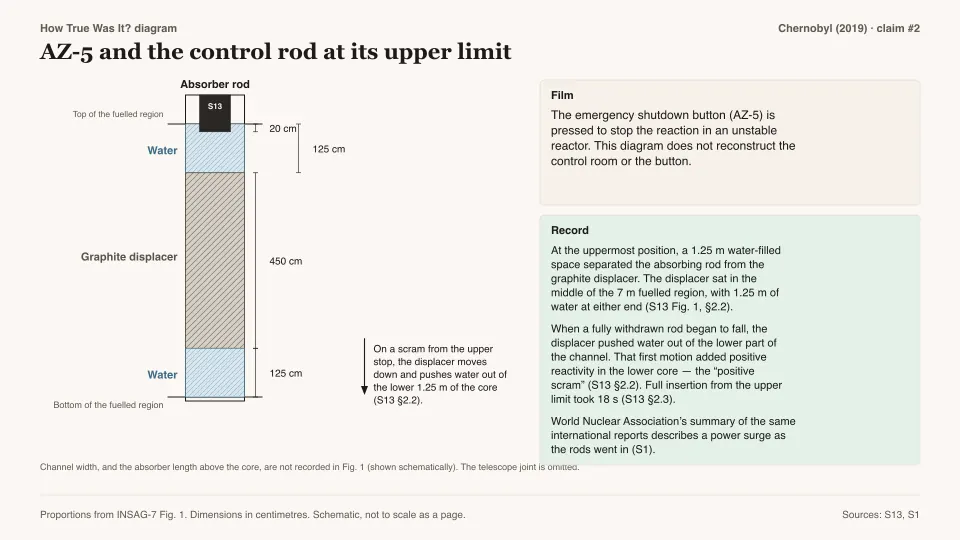
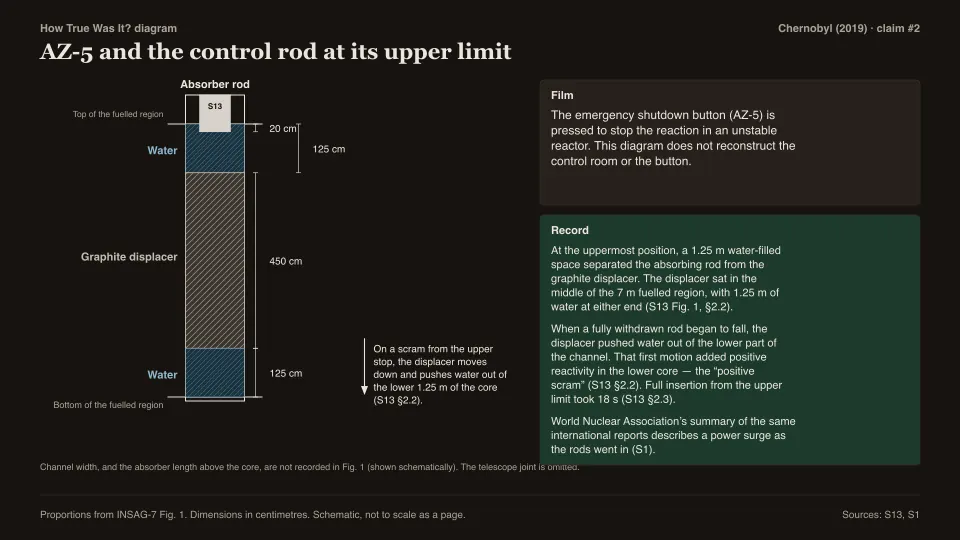
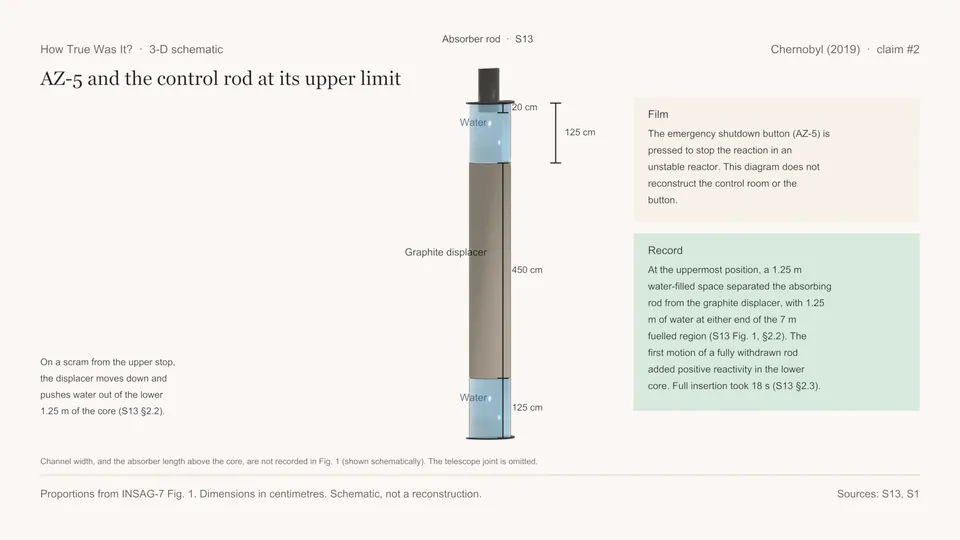
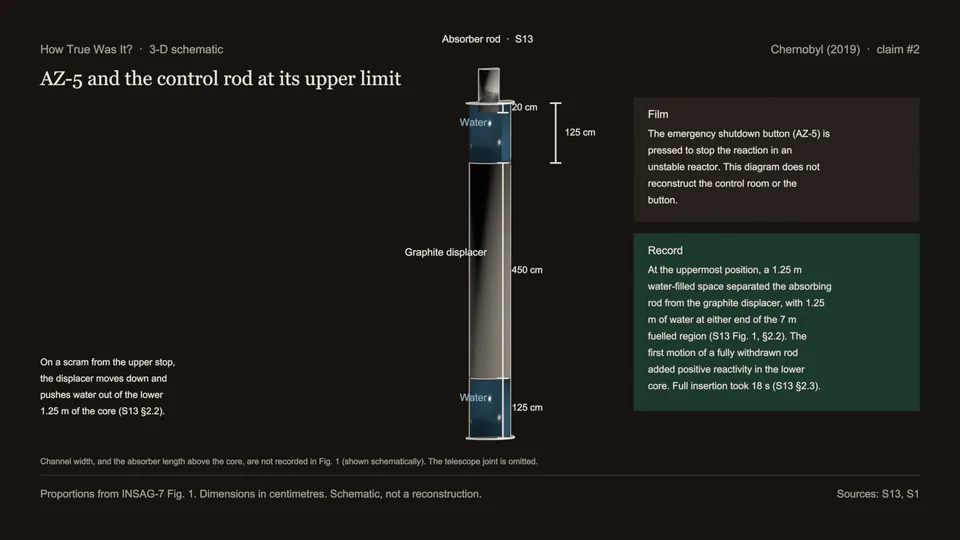
| 2 | The cause comes down to a design flaw: in an unstable reactor, pressing the emergency shutdown button makes the power spike instead of fall. | True | The World Nuclear Association says a peculiarity of the control rod design caused a dramatic power surge as the rods were inserted, in a reactor whose design let more steam mean more power. The 1992 international report put the emphasis on these design features. INSAG-7 Fig. 1 and §§2.2–2.3 give the rod at its upper limit: a 1.25 m water-filled gap between the absorber and the graphite displacer, 1.25 m of water at either end of the 7 m fuelled region, and an 18 s insertion from the upper stop, during which the first motion added positive reactivity in the lower core. | S1 S13 | 2026-11-22 |
| 3 | Deputy chief engineer Anatoly Dyatlov is a bully who forces the test through and then denies the reactor has exploded. | Partly | Higginbotham says Dyatlov could be peremptory and dictatorial but was respected for his expertise and was more sympathetic than the series suggests. Former plant staff told the Kyiv Post he had a rough temper but was no coward or madman. Later reviews found the operators had not been told how dangerous the reactor was at low power. | S4 S6 S1 | 2026-11-22 |
| 4 | Ulana Khomyuk, a nuclear physicist from Minsk, works out what happened and pushes Legasov to tell the truth. | Invented | She did not exist. The series says so in its closing titles, where she stands for the many scientists who worked on the accident. Higginbotham says he knows of no woman at that level of the government commission. | S3 S4 | 2026-11-22 |
| 5 | Boris Shcherbina threatens to have Legasov thrown from a helicopter or shot, and officials throughout keep people in line with threats of execution. | Invented | Masha Gessen writes that summary executions on one official's word had not been part of Soviet life since the 1930s and that people mostly did as they were told without such threats. Higginbotham says he has no evidence that any of the scenes between the two men took place. | S3 S4 | 2026-11-22 |
| 6 | A helicopter crashes into the reactor site while dropping sand and boron on the fire in the first days. | Partly | Helicopters did drop about 5,000 tonnes of material on the core in the first ten days. A helicopter did crash at the site, but in early October 1986, when its rotor hit a cable on a construction crane during the building of the sarcophagus. | S4 S5 S1 | 2026-11-22 |
| 7 | Three plant workers volunteer for what looks like a suicide mission, wading through flooded corridors to open drain valves under the reactor. | Partly | Three men did open the valves, and all three survived, as the series says at the end. But they were plant staff on shift who were given the job. One of them, Oleksiy Ananenko, told the Kyiv Post: “It was an order from above. I was not a volunteer.” Boris Baranov died of heart disease in 2005. | S4 S6 S12 | 2026-11-22 |
| 8 | If the valves are not opened, a steam explosion of two to four megatons will destroy the other reactors and leave much of Europe uninhabitable. | Partly | The danger behind the scene was real: Sky History says molten fuel was melting toward the flooded pools under the reactor, where it would have caused a steam explosion, and the pools had to be drained by opening valves in the basement. The scale is not. Higginbotham says the several-megaton explosion is not true to life, and Sky History's figure of three to five megatons is a statement it attributes to the physicist Vassili Nesterenko and does not verify. | S4 S12 | 2026-11-23 |
| 9 | Coal miners dig a tunnel under the reactor, and work naked because of the heat. | Partly | Miners and subway workers did tunnel under the reactor. Higginbotham says film and photographs show them working clothed and that none of the people he interviewed remembered otherwise. Series creator Craig Mazin has said the tunnel turned out not to be needed. | S4 | 2026-11-22 |
| 10 | A dying firefighter is so radioactive that he is a danger to his pregnant wife, and her baby dies because it absorbed the radiation. | Partly | Firefighters were flown to a Moscow hospital and some died there of radiation sickness, and the child died. But Robert Gale, who helped treat those patients, writes that none of them was dangerously radioactive to others, and that the baby's death is extraordinarily unlikely to have had anything to do with radiation. | S7 S8 | 2026-11-22 |
| 11 | Pripyat residents watch the fire from a railway bridge, and the closing titles say it has been reported that none of them survived. | Partly | People did go to the bridge. Higginbotham, who spent more than a decade interviewing eyewitnesses, spoke to a man who cycled there that night, aged seven or eight, to look at the reactor. The rest is not supported: Higginbotham says he could find no evidence that those on the bridge later died, and the man he interviewed is apparently perfectly healthy. | S5 | 2026-11-23 |
| 12 | Pripyat is not evacuated until the day after the explosion. | True | The town was evacuated on 27 April. Prosecutors at the 1987 trial said residents had not been warned of the high radiation until 36 hours after the accident. | S1 S10 | 2026-11-22 |
| 13 | Legasov presents the Soviet account of the accident in Vienna, and that account puts the blame on the operators. | True | Legasov led the Soviet delegation to the Vienna review meeting in August 1986, and his long and candid presentation was widely respected. The international report that followed blamed the operators for breaking the rules. The 1992 report revised that. | S9 S1 | 2026-11-22 |
| 14 | At the 1987 trial of three plant managers, Legasov takes the stand and explains to the court how the reactor's design caused the explosion. | Invented | There was a trial in July 1987, but Gessen calls the series version entirely fictional, with a speech of a kind Soviet courts did not feature. Time magazine's report from the trial lists six defendants, not three. | S3 S10 | 2026-11-22 |
| 15 | Legasov records his memories on tape and takes his own life two years after the explosion. | True | He died on 27 April 1988, aged 51, the day after the second anniversary. He had dictated memoirs into a recorder, and Pravda published extracts on 20 May 1988. This entry found no source for the series' detail of him hiding the tapes from watchers. | S9 | 2026-11-22 |
| 16 | The closing titles say the official Soviet death toll is 31 and that estimates of the real toll range from 4,000 to 93,000. | True | Gale counts 31 immediate deaths: 29 patients and two men killed at the plant. A 2005 United Nations study estimated up to about 4,000 eventual deaths among the most exposed. Higginbotham cites estimates of 9,000 to 15,000 fatal cancers and says figures as high as 200,000 have no scientific basis. The total is disputed. | S7 S1 S2 S5 | 2026-11-22 |
True: supported as shown. Partly: changed in who, when, how or how much. Invented: no sign of it in the record, or contradicted. Unclear: the record is thin or disputed. How we rate. Each row has a permanent link (#claim-N); use Copy link to share one claim.
Sources
- S1“Chernobyl Accident 1986”, World Nuclear Association, 2026-11-20.institutional Link · accessed 2026-11-22
Note: An industry body's summary of the international reports, including the International Atomic Energy Agency's 1992 INSAG-7 report. The date is the page's last-updated date. - S2“Chernobyl: the true scale of the accident”, World Health Organization, International Atomic Energy Agency and United Nations Development Programme (joint news release), 2005-09-05.institutional Link · accessed 2026-11-22
- S3Masha Gessen, “What HBO's “Chernobyl” Got Right, and What It Got Terribly Wrong”, The New Yorker, 2019-06-04.news Link · accessed 2026-11-22
- S4Nick Lucchesi (interview with Adam Higginbotham), “‘Chernobyl’ on HBO: Author of ‘Midnight in Chernobyl’ Separates Fact From Fiction”, Inverse, 2019-05-24.interview Link · accessed 2026-11-22
Note: Higginbotham had seen the first three episodes when he gave this interview. - S5Dawn Stover (interview with Adam Higginbotham), “The human drama of Chernobyl”, Bulletin of the Atomic Scientists, 2019-05-05.interview Link · Archive · accessed 2026-11-23
Via: Internet Archive copy. The live site returned 403 to automated access on the day we checked. - S6Bermet Talant, “Real-life heroes of Chornobyl talk disaster, HBO show”, Kyiv Post, 2019-06-14.news Link · accessed 2026-11-22
- S7Robert Peter Gale, “Chernobyl, the HBO miniseries: Fact and fiction (Part II)”, The Cancer Letter, 2019-05-24.secondary Link · accessed 2026-11-22
Note: Gale is a physician who helped treat the Chernobyl radiation patients in Moscow in 1986. - S8Robert Peter Gale, “Chernobyl, the HBO miniseries: Fact and fiction (Part IV)”, The Cancer Letter, 2019-06-21.secondary Link · accessed 2026-11-22
- S9“Legasov suicide leaves unanswered questions”, Nuclear Engineering International, 1988-07.contemporaneous news Link · accessed 2026-11-22
Note: First published in July 1988 and put online in 2006. - S10John Greenwald, “Disasters: Judgment at Chernobyl”, Time, 1987-07-20.contemporaneous news Link · accessed 2026-11-22
Note: We read the second of the article's three pages. - S11“The man held responsible for the Chernobyl accident has died”, American Nuclear Society, Nuclear Newswire, 2021-11-02.news Link · accessed 2026-11-22
- S12“The real story of the Chernobyl divers”, Sky History.secondary Link · accessed 2026-11-22
- S13International Nuclear Safety Advisory Group, “The Chernobyl Accident: Updating of INSAG-1 (INSAG-7)”, International Atomic Energy Agency, 1992.official record Link · accessed 2026-11-23
Note: Fig. 1 (uppermost position of a control rod of the RBMK emergency protection system; dimensions in centimetres: 20, 125, 450, 125) and §§2.2–2.3 (1.25 m water-filled space, graphite displacer, 18 s insertion, positive scram). Opened from the IAEA PDF. Official PDF of INSAG-7 (same 1992 IAEA publication as the catalogue page https://www.iaea.org/publications/3699/the-chernobyl-accident-updating-of-insag-1, which this box could not open).
Every claim cites at least one source. A not verified tag means we have not opened the original yet. Our source rules.
Evidence log
- First draft. 16 claims checked against 12 sources.
- update Added INSAG-7 as S13 and cited it on claim #2. Added an original AZ-5 / control-rod schematic (light and dark) under the verdict, mapped to S13 and S1. Channel width and the absorber length above the core are labelled not recorded.
- update Added a companion 3-D schematic (light and dark), built procedurally in Blender from the same sources as the flat diagram (S13, S1). Channel width, the absorber length above the core, and the telescope joint remain omitted or labelled not recorded. No control-room reconstruction.
- Verify pass fix: claims 8 (steam explosion) and 11 (railway bridge) changed from Invented to Partly. S5 re-read from an Internet Archive copy.
- Replaced the IAEA catalogue URL for S13 (INSAG-7) with the official openable PDF of the same publication.
- update Status set to published for the howtruewasit.com launch.
- update Last-reviewed date set to 2026-11-23 for the howtruewasit.com launch.
Spotted an error or have a better source?
Email [email protected] with the claim number (for example #claim-3) and the source. If we verify the change, we log it with the date in the Evidence log.
Read next
Verdicts describe what is shown on screen, not the honesty of anyone named or of the filmmakers.
Last reviewed: 2026-11-23 · Report an error · Back to top