Film · 1997
Titanic
James Cameron's 1997 film sinks the ship much as the 1912 inquiries and the wreck describe it, then puts two invented lovers at the rail and takes liberties with a few real officers and owners.
Diagram

What really happened
The Titanic left Southampton on 10 April 1912, called at Cherbourg and Queenstown, and headed for New York with about 2,200 people aboard. The British inquiry later counted 2,201. Edward J. Smith was captain. Bruce Ismay, chairman of the White Star Line, and Thomas Andrews of the shipbuilders Harland and Wolff were among the passengers.[S6][S1][S2] Claim 1 ↓
The ship received ice warnings through the voyage. The British inquiry found that the whole crossing was made at high speed, about 22 knots at the end, and that the speed was never reduced until a collision could not be avoided. The lookouts had no binoculars. At about 11:40 pm on Sunday 14 April they reported an iceberg dead ahead. First Officer William Murdoch ordered the helm hard over and the engines reversed, but the ship struck on her starboard side. She sank two hours and forty minutes later, at 2:20 am.[S1][S6] Claims 2–4 ↓
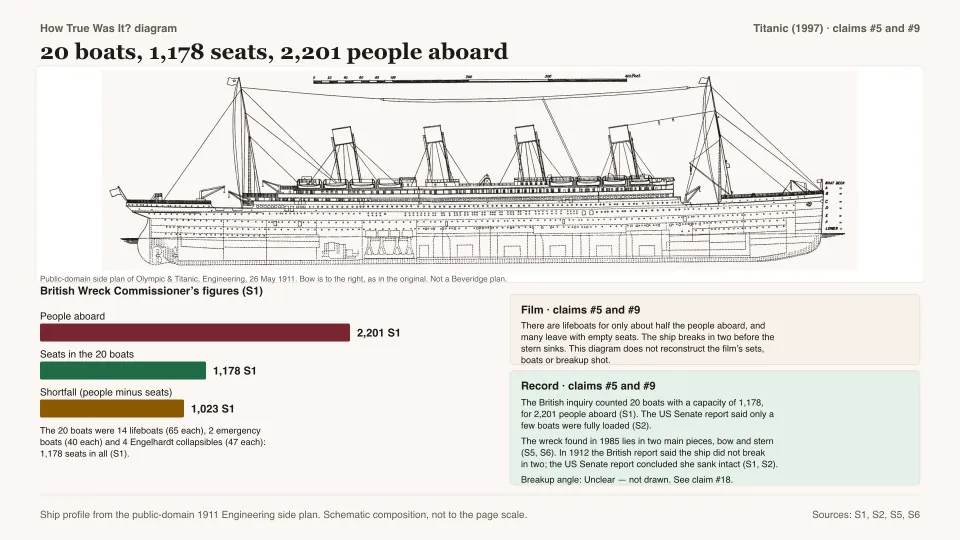
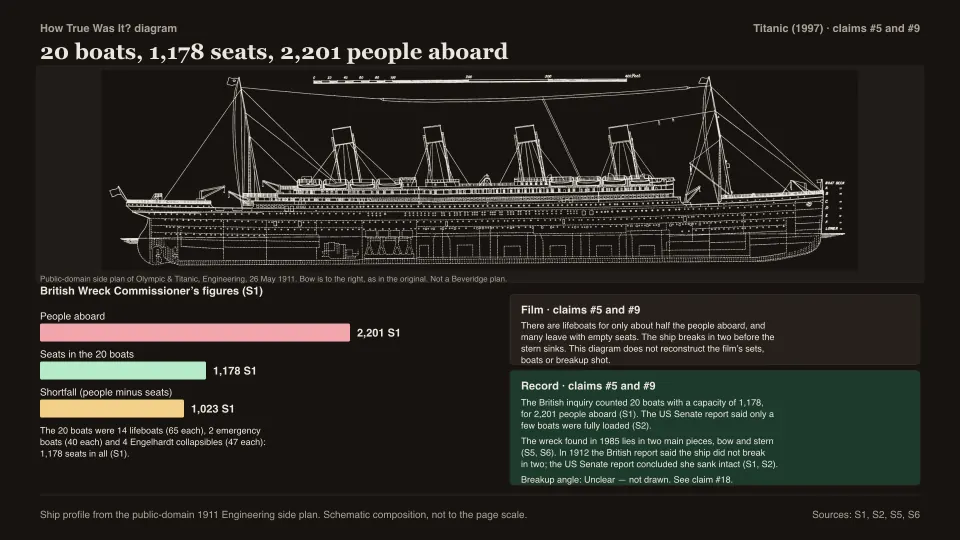
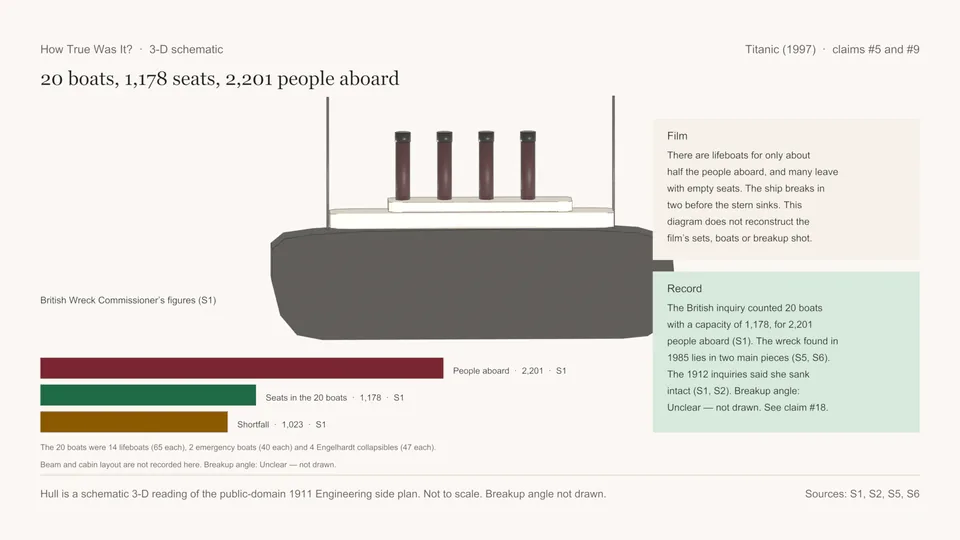
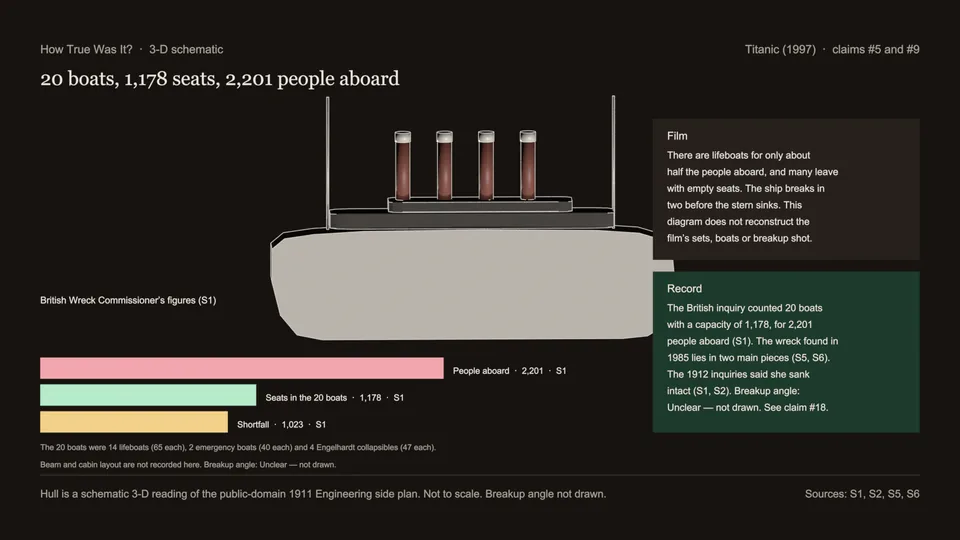
There were 20 boats with room for 1,178 people. That was more than the regulations required and far fewer than the number aboard. Boats were loaded women and children first, and many left partly empty. The US Senate committee concluded that the failure to fill them cost several hundred lives. The ship's musicians played as the boats were loaded. None of them survived.[S1][S2][S6] Claims 5, 10 ↓
As the bow went under, the stern rose out of the water. Britannica's account, written with the wreck in mind, says the lights went out at about 2:18 am and the hull then broke in two. In 1912 both inquiries concluded the opposite, that she went down in one piece. The wreck was found on 1 September 1985 about 13,000 feet down, in two main pieces.[S6][S5][S1][S2] Claim 9 ↓
The Cunard liner Carpathia picked up the first boat at about 4:10 am and took 712 people aboard in all, one of whom died soon after. By the British inquiry's count 711 of 2,201 were saved: about 62 percent of first-class passengers, 41 percent of second class, 25 percent of third class and 24 percent of the crew. The inquiry gave the number of lives lost as 1,490. Britannica puts the toll at more than 1,500.[S1][S6] Claims 8, 14 ↓
A US Senate inquiry opened within days and a British inquiry under Lord Mersey followed in May. The British report blamed the loss on a collision with an iceberg brought about by excessive speed. Both inquiries made safety recommendations, and an international conference in 1913 drew up rules that required lifeboat space for everyone aboard, lifeboat drills and a round-the-clock radio watch.[S7][S1]
What the film leaves out
The film leaves out the Californian, a liner that had stopped for the night in the ice with her wireless switched off. Her crew saw rockets and did not come. Both inquiries condemned her captain, Stanley Lord. Britannica notes that many experts now think she was about 20 miles away and could not have reached the Titanic before it sank.[S7][S6]
It also says little about the rescue. The Carpathia was about 58 nautical miles away when she picked up the distress call and took more than three hours to arrive, steering through ice at full speed. The British inquiry recorded its great admiration for her captain, Arthur Rostron.[S6][S1][S2]
All 18 claims, each rated and sourced
| # | What the film shows | Verdict | What the record shows | Sources | Checked |
|---|---|---|---|---|---|
| 1 | Jack Dawson, a penniless artist in third class, and Rose DeWitt Bukater, a first-class passenger engaged to a steel heir, meet and fall in love on the voyage. | Invented | Britannica describes the romance between Rose and Jack as fictional. A man named J. Dawson did die in the sinking and is buried in Halifax, Nova Scotia. He was Joseph Dawson, listed in the Halifax medical examiner's file as a member of the engine department. CBC News reports that director James Cameron has said there is no connection between that grave and his character. | S9 S11 S12 | 2026-11-22 |
| 2 | The ship strikes an iceberg late on the night of 14 April 1912 and sinks a little over two and a half hours later, at about 2:20 am. | True | The British inquiry found that the ship foundered two hours and forty minutes after the collision and disappeared at 2.20 a.m. Britannica puts the sighting of the iceberg at about 11:40 pm. The US Senate report gives 11:46 pm ship's time for the lookout's warning. | S1 S2 S6 | 2026-11-22 |
| 3 | The lookouts in the crow's nest have no binoculars. | True | Asked whether binoculars were provided for and used by the lookout men, the British inquiry answered no. It also answered no when asked whether they were necessary or usual in such conditions, so the film's suggestion that they would have saved the ship goes further than the inquiry did. | S1 S6 | 2026-11-22 |
| 4 | Bruce Ismay pushes Captain Smith to raise speed so that the ship arrives early and makes headlines. | Unclear | Sworn accounts conflict. First-class passenger Elizabeth Lines testified in 1913 that on the Saturday afternoon she overheard Ismay tell Captain Smith they would beat the sister ship Olympic and get in to New York on Tuesday. Ismay told the US Senate that he never consulted with the captain about the movement of the ship and that the plan was not to arrive before Wednesday morning. The British inquiry found the speed was never reduced but did not blame Ismay for it. | S4 S3 S1 | 2026-11-22 |
| 5 | There are lifeboats for only about half the people aboard, and many of them leave with empty seats. | True | The British inquiry counted 20 boats with a capacity of 1,178, for 2,201 people aboard. The US Senate report said only a few boats were fully loaded and that the failure to use their capacity needlessly cost several hundred lives. Britannica notes that the first boat away held about 27 people and had room for 65. | S1 S2 S6 | 2026-11-22 |
| 6 | First Officer William Murdoch accepts money from a passenger in return for a place in a lifeboat. | Invented | Nothing of the kind appears in either inquiry report or in any account read for this entry. The British report records Murdoch's orders to avoid the iceberg, and the BBC says historians describe him as having done his utmost to get passengers into the boats. In April 1998 a 20th Century Fox executive went to Murdoch's home town of Dalbeattie, Scotland, apologized to his nephew and gave money to a school prize in Murdoch's name. | S13 S14 S1 | 2026-11-22 |
| 7 | Murdoch shoots passengers who rush a boat and then shoots himself. | Unclear | Shots were fired that night. Britannica says Fifth Officer Harold Lowe fired three times to keep men from rushing boat 14. A few survivors said they saw an officer shoot a man and then himself. First-class passenger George Rheims wrote so to his wife on 19 April 1912, without naming the officer. Researchers Bill Wormstedt and Tad Fitch, who collected the accounts, conclude that whether it happened, and who it was, will probably never be known. Murdoch's family and home town reject the film's version. | S15 S13 S6 | 2026-11-22 |
| 8 | Third-class passengers are held below decks behind locked gates while the boats are filled. | Partly | Third class did fare worst among passengers: the British inquiry counted 178 saved out of 706, about 25 percent, against 62 percent in first class. But it found no truth in the suggestion that they were held back, and the lawyer for third-class families told the court no evidence supported that charge. The US Senate report said no distinction was made between classes in loading the boats. Britannica says the claims were largely dispelled and points to the lack of a general alarm and the difficulty of finding the way up. | S1 S2 S6 | 2026-11-22 |
| 9 | The ship breaks in two before the stern sinks. | True | Britannica's account has the hull breaking in two after the lights failed at about 2:18 am, and the wreck found in 1985 lies in two main pieces, bow and stern. In 1912 the British report said the ship did not break in two, and the US Senate report, while noting conflicting statements, concluded she sank intact. | S6 S5 S1 S2 | 2026-11-22 |
| 10 | The ship's musicians keep playing on deck as the boats are lowered, and all of them die. | True | Britannica says the musicians played first in the first-class lounge and then on deck, that sources differ on how long they went on, and that none survived. Don Lynch, the Titanic Historical Society historian who advised the film, told History.com they made no effort to save themselves. | S6 S19 | 2026-11-22 |
| 11 | The last piece the band plays is the hymn Nearer, My God, to Thee. | Unclear | Britannica calls the last song a matter of speculation and says it was likely either Autumn or Nearer My God to Thee. Lynch says the hymn was among the songs played because many people claimed to have heard it. Neither source can say it was the last. | S6 S19 | 2026-11-22 |
| 12 | An elderly first-class couple stay aboard together and die holding each other in bed as the water comes in. | Partly | The couple are based on Isidor and Ida Straus, and the choice to stay together is real. According to the UK National Archives, both were directed to lifeboat 8. Isidor refused to go while younger men were being kept out, and Ida refused to leave him. She gave her fur coat to her maid, who survived. They were last seen together on deck, holding hands, not in their cabin. | S16 S6 | 2026-11-22 |
| 13 | Margaret Brown, in a lifeboat with empty seats, urges the crewman in charge to go back for people in the water, without success. | True | Titanic museum curator Paul Burns told History.com there are true accounts saying she did that. The UK National Archives says she was put into lifeboat 6, which was under Quartermaster Robert Hichens, and that she and the other women rowed and kept spirits up against his gloom. Britannica adds that she was never called Molly in her lifetime. | S19 S17 S20 | 2026-11-22 |
| 14 | After the ship goes down, one officer empties his boat into others and rows back to look for survivors, and finds very few alive. | True | The US Senate report says Fifth Officer Lowe distributed his passengers among other boats and, after the cries had died away, took boat 14 back to the wreck and pulled four living people from the water, one of whom died. It adds that a few people were picked up by boats that stayed near the ship, and that many lives might have been saved had the boats returned promptly. | S2 S6 | 2026-11-22 |
| 15 | Captain Smith goes into the wheelhouse alone and dies there when the windows give way. | Unclear | Britannica says Smith was last seen on the bridge and that his body was never found. Historian Tim Maltin told History.com that, according to some accounts, he dived into the sea from the front of the wheelhouse and helped people toward the boats. Nobody who saw his last moments is known to have survived to settle it. | S10 S19 | 2026-11-22 |
| 16 | Thomas Andrews, who oversaw the ship's design, is last seen standing alone in the first-class smoking room. | True | The UK National Archives records that steward John Stewart said he saw Andrews moments before the ship went down, standing silently in the first-class smoking room with his lifebelt lying discarded nearby. His body was never recovered. | S18 | 2026-11-22 |
| 17 | Before she sails, everyone from the owners to the passengers calls the Titanic unsinkable. | Partly | Some people did. Britannica says newspaper articles and the shipping line's own advertising materials advanced the idea, and that a company vice president told Congress he had thought the ship unsinkable. But it says most coverage before the sinking sold size and luxury, not safety, and that the word really took hold afterwards. | S8 S5 | 2026-11-22 |
| 18 | The ship breaks apart at a steep, nearly vertical angle. | Unclear | Neither 1912 inquiry gives a breakup angle, because both concluded that the ship sank intact. Both describe a steep final position: the British report says she did eventually attain the perpendicular, and the US Senate report, after noting conflicting statements about whether she broke in two, says she assumed an almost perpendicular position just before sinking (S1, S2). Later commentary, including a 2021 ScreenRant summary of James Cameron’s later model work, reports that she broke at a much shallower angle, about 23 degrees (S21). We have not treated that later figure as settled, so this claim is Unclear. This entry does not include an angle graphic. | S1 S2 S21 | 2026-11-23 |
True: supported as shown. Partly: changed in who, when, how or how much. Invented: no sign of it in the record, or contradicted. Unclear: the record is thin or disputed. How we rate. Each row has a permanent link (#claim-N); use Copy link to share one claim.
Sources
- S1Lord Mersey, Wreck Commissioner, “Report on the Loss of the “Titanic” (s.s.): Report of the Court (British Wreck Commissioner's Inquiry)”, Titanic Inquiry Project (transcription of the 1912 report), 1912-07-30.official record Link · accessed 2026-11-22
Note: Sections read: the collision, speed of the ship, final effect of the damage, boats and their capacity, third-class passengers, numbers saved, conduct of Sir Cosmo Duff Gordon and Mr Ismay, the rescue by the Carpathia, and the Court's answers to the 26 questions. - S2US Senate Committee on Commerce, ““Titanic” Disaster: Report of the Committee on Commerce, United States Senate (Senate Report No. 806, 62nd Congress, 2nd Session)”, Titanic Inquiry Project (transcription of the 1912 report), 1912.government Link · accessed 2026-11-22
Note: Sections read: the voyage and speed, the collision, abandoning ship, conduct on lifeboats, ship sinking, the rescue. - S3J. Bruce Ismay, “United States Senate Inquiry, Day 1: Testimony of Joseph Bruce Ismay”, Titanic Inquiry Project, 1912-04-19.official record Link · accessed 2026-11-22
- S4Elizabeth L. Lines, “Deposition of Elizabeth L. Lines (Limitation of Liability Hearings, US District Court, Southern District of New York)”, Titanic Inquiry Project, 1913-11-22.court record Link · accessed 2026-11-22
Note: Taken at the American Consulate-General in Paris for the lawsuit over the White Star Line's liability. - S5Amy Tikkanen, “Titanic”, Encyclopaedia Britannica, 2024-12-25.secondary Link · Archive · accessed 2026-11-22
Via: Internet Archive copy. The live site blocked automated access on the day we checked.
Note: Overview page, including the discovery of the wreck. The date is the article's last-updated date on the archived copy. - S6Amy Tikkanen, “Titanic: Maiden voyage, sinking and rescue”, Encyclopaedia Britannica, 2026-10-26.secondary Link · Archive · accessed 2026-11-22
Via: Internet Archive copy. The live site blocked automated access on the day we checked.
Note: Second page of the same article. The date is the last-updated date on the archived copy. - S7Amy Tikkanen, “Titanic: Aftermath and investigation”, Encyclopaedia Britannica.secondary Link · Archive · accessed 2026-11-22
Via: Internet Archive copy. The live site blocked automated access on the day we checked.
Note: Third page of the same article: the two inquiries, the Californian and the 1913 safety conference. - S8The Editors of Encyclopaedia Britannica, “Did Anyone Really Think the Titanic Was Unsinkable?”, Encyclopaedia Britannica.secondary Link · Archive · accessed 2026-11-22
Via: Internet Archive copy. The live site blocked automated access on the day we checked. - S9Alison Eldridge, “Titanic (film by Cameron, 1997)”, Encyclopaedia Britannica, 2025-12-16.secondary Link · Archive · accessed 2026-11-22
Via: Internet Archive copy. The live site blocked automated access on the day we checked.
Note: The date is the article's last-updated date on the archived copy. - S10Amy Tikkanen, “Edward J. Smith”, Encyclopaedia Britannica.secondary Link · Archive · accessed 2026-11-22
Via: Internet Archive copy. The live site blocked automated access on the day we checked. - S11“Titanic film fans flock to Halifax for J. Dawson grave”, CBC News, 2012-04-05.news Link · accessed 2026-11-22
- S12“RMS Titanic Resource Guide: Fatality Reports, Body No. 227, Joseph Dawson (Medical Examiner, City of Halifax and Town of Dartmouth, RG 41 vol. 76 no. 227)”, Nova Scotia Archives, 1912.official record Link · accessed 2026-11-22
- S13“Titanic makers say sorry”, BBC News, 1998-04-15.contemporaneous news Link · Archive · accessed 2026-11-23
Via: Internet Archive copy. The live BBC News URL returned HTTP 500 when rechecked on 2026-11-23. - S14“An Icy Reaction”, The Spokesman-Review, 1998-04-16.contemporaneous news Link · accessed 2026-11-22
- S15Bill Wormstedt and Tad Fitch, “Shots in the Dark: Did an Officer Commit Suicide on the Titanic in the Last Stages of the Sinking?”, wormstedt.com, 2013.secondary Link · accessed 2026-11-22
Note: A long-running compilation of survivor accounts by two Titanic researchers, first posted in 1999. Pages read: introduction, primary accounts, primary accounts with no mention of a suicide, and conclusion. - S16“Stories from the Titanic: The story of Isidor and Ida Straus”, The National Archives (UK).institutional Link · Archive · accessed 2026-11-22
Via: Internet Archive copy. The page is no longer on the live site. - S17“Stories from the Titanic: The story of Margaret ‘Molly’ Brown”, The National Archives (UK).institutional Link · Archive · accessed 2026-11-22
Via: Internet Archive copy. The page is no longer on the live site. - S18“Stories from the Titanic: The story of Thomas Andrews”, The National Archives (UK).institutional Link · Archive · accessed 2026-11-22
Via: Internet Archive copy. The page is no longer on the live site. - S19Becky Little, “The True Stories That Inspired ‘Titanic’ Movie Characters”, History.com, 2017-12-01.news Link · accessed 2026-11-22
Note: Interviews with Don Lynch, Paul Burns and Tim Maltin. - S20Kristen Iversen, “Molly Brown”, Encyclopaedia Britannica.secondary Link · Archive · accessed 2026-11-22
Via: Internet Archive copy. The live site blocked automated access on the day we checked.
Note: Iversen is the author of a 1999 biography of Brown. - S21Christy Box, “What James Cameron Got Wrong About The Titanic's Sinking In 1997”, ScreenRant, 2021-06-06.secondary Link · accessed 2026-11-22
Note: Opened from a saved copy of the article. It reports Cameron’s later model work putting the breakup at about 23 degrees, not the nearly vertical angle in the film. Used only as later commentary; this entry does not treat 23 degrees as a settled figure.
Every claim cites at least one source. A not verified tag means we have not opened the original yet. Our source rules.
Evidence log
- First draft. 17 claims checked against 20 sources, including the 1912 British and US inquiry reports, Ismay's Senate testimony and a 1913 court deposition.
- update Split out claim #18 on the breakup angle (Unclear): the 1912 inquiries do not give an angle, and later commentary is not treated as settled. No angle graphic was added. Added an original boats diagram on the public-domain 1911 Engineering side plan (20 boats, 1,178 seats, 2,201 aboard) under the verdict, mapped to S1, S2, S5 and S6. Added S21 (ScreenRant, later commentary on Cameron’s 23-degree figure).
- update Added a companion 3-D schematic (light and dark), built procedurally in Blender from the same sources as the flat diagram (S1, S2, S5, S6 and the 1911 Engineering side plan). The hull is a schematic reading of that plan, not a cabin survey. Twenty lifeboats are not placed on deck (positions not used). Breakup angle still not drawn (claim #18, Unclear). Beam and cabin layout remain labelled not recorded.
- Verify pass fix: claim 18 now says both 1912 inquiries describe a near-perpendicular final position while concluding the ship sank intact.
- Added an Internet Archive copy for S13 (BBC News, 'Titanic makers say sorry'), because the live URL returned HTTP 500 on recheck.
- update Status set to published for the howtruewasit.com launch.
- update Last-reviewed date set to 2026-11-23 for the howtruewasit.com launch.
Spotted an error or have a better source?
Email [email protected] with the claim number (for example #claim-3) and the source. If we verify the change, we log it with the date in the Evidence log.
Read next
Verdicts describe what is shown on screen, not the honesty of anyone named or of the filmmakers.
Last reviewed: 2026-11-23 · Report an error · Back to top